Britannic Sinks Near Kea
21 September 2026 - 8:12am
 On the morning of 21st November 1916, HMHS Britannic sank in the Aegean Sea, three kilometres off the Greek Cycladic island of Kea, near Port Nicholaos. Britannic was a British hospital ship on her way to Lemnos, to pick up sick and wounded British and Allied soldiers from the Mediterranean campaign of WW1, when she struck a German mine at 08:12 and sank in only 55 minutes. 30 people, mostly crew, died when their lifeboat was sucked under one of her three propellers, as Britannic sank by the bow. 1,036 passengers and crew survived, including her Capitain Charles Bartlett, the last man to leave the sinking ship. Captain Bartlett was still wearing his pyjamas when he was picked up by a fleet of Greek fishing boats and three naval destroyers that came to the rescue that warm sunny morning.
HMHS Britannic was one of three Olympic size transaltlantic liners built in Belfast by the White Star Line company. Her sister ships were the luxury liners RMS Olympic, and the tragic RMS Titanic which sank in the North Atlantic at 02:20 on 15th April 1912 after hitting an iceberg. About 1,517 passengers and crew were lost as it took 2 hours and 40 minutes for Titanic to sink. Britannic lost 30 crew, but only took 55 minutes to sink, due to the mine blast and many watertight doors and most portholes that were left open.
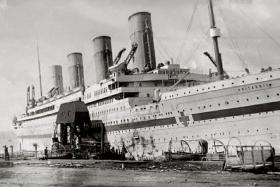
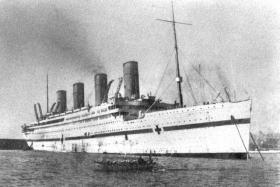
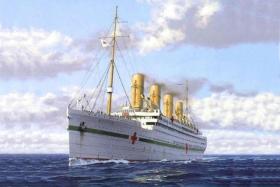
Since the RMS Titanic disaster in 1912, Britannic had many safety features made to her before her launch on 26th February 1914. Modifications included more lifeboats, watertight compartments increased to 17, five of which were raised from E deck to B deck. Britannic was originally scheduled to begin its commercial service the following year, but with the start of World War One in 1914, RMS Britannic was requisitioned as a hospital ship in 1915, becoming HMHS Britannic, with a total repaint to white and yellow, with clear red cross symbols along her 882' (269m) length. With a gross tonnage of 48,158, she became the largest of the three sisters.
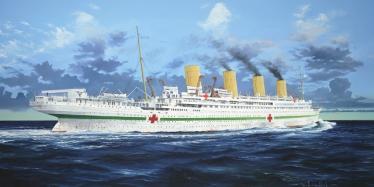
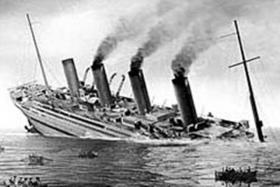
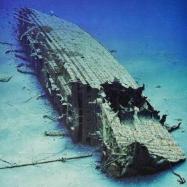
Although the mine blast damage was extensive, only six watertight compartments flooded and the large ship remained afloat. As the ship listed, water began to enter open portholes on the starboard side. In an attempt to beach the ship off Kea, Capt. Bartlett ordered full speed, the movement caused more water to enter the ship, and Capitain Bartlett quickly ordered the engines stopped. At approximately 09:07 HMHS Britannic sank to the bottom of the Aegean Sea.
Britannics oldest sister ship, RMS Olympic, was launched on 20th October 1910 and made her maiden voyage on 14th June 1911 from Southampton, via Cherbourg and Queenstown, to New York. Olympic served as a troopship during WW1, even ramming and sinking German U-boat SM U-103 in 1918. RMS Olympic completed her final regular voyage on 12th April 1935 and retired from passenger service after a very successful 24-year career, later being sold and dismantled as scrap in Jarrow by the end of 1937.
Britannics other sister ship, RMS Titanic, was launched on 31st May 1911 and made her maiden voyage on 10th April 1912 from Southampton, via Cherbourg and Queenstown on her way to New York. Onboard were some 2,200 passengers and crew. About 23:40 on the fourth day of her maiden voyage, Titanic struck an iceberg 400 nautical miles south of Newfoundland. Captain Edward J.Smith ordered distress singnals sent and the launching of lifeboats, with orders for women and children first. There were only 20 lifeboats on the Titanic, 4 of which were collapsables, only enough for half the people on board. RMS Titanic sank around 02:20 with over 1,500 passengers and crew lost at sea. Only 705 survivors were rescued from the lifeboats by the RMS Carpathia.
In 1975, French ocean explorer Jacques Cousteau discovered the wreakage of the Britannic. The British hospital ship was found lying on its starboard side at a depth of approximately 390' (120m). HMHS Britannic was intact except for the large hole in its bow.