Fall of Troy Anniversary
24 April 2025 - 9:00am
 24th April 1183 BC has been the date selected to represent the legendary fall of Troy over 3,200 years ago. The Trojan War was waged against Priam's city of Troy by the Achaean Greeks after Prince Paris of Troy took the beautiful Helen from her husband, King Menelaus of Sparta. The ten year war during the Late Bronze age was one of the important events in Greek mythology and has been narrated through many works of Greek literature, most notably Homer's Iliad and Odyssey. Those who believe that the stories of the Trojan War derive from a historical conflict, date it to the late-12th century BC, preferring the dates given by Eratosthenes as late Spring 1183 BC, which corresponds to archaeological evidence of the destruction of Troy Troia VII and the following Bronze Age collapse of Mycenaean cities.
The ancient story describes that after ten long years of seige warfare, the Achaean Greeks came up with a clever way to achieve their goal of breaking through the walls of King Priam's city of Troy. Led by a plan by Odysseus, the Achaeans made a show of burning their camp and sailing away for the island of Tenedos. However, just before they departed, the Greeks left a large wooden horse as a gift for the victorious people of Troy, a wooden horse* with forty Greek soldiers hidden inside. The Trojans opened their city gates and wheeled in their prize. As the Trojans celebrated their victory and the wine flowed freely, everyone finally passed out in a drunken stupor. This was when the hidden Achaeans emerged from their hiding place within the wooden horse and opened the city gates. The waiting Greek army rushed through the gates and pillaged the city, killing all the males, even the infants. All the younger women and girls were enslaved and anything of any worth was hauled away. Troy was then razed to the ground until there was nothing left but rubble and corpses. "Beware of Greeks bearing gifts" has been a saying passed down through history.
 British archaeologist and local expert Frank Calvert originally identified the hill of Hissarlick, on the Trojan plain of modern Turkey, in 1868 as the site of ancient Troy. Calvert suggested that the wealthy German businessman, adventurer and amateur archaeologist Heinrich Schliemann start digging for evidence of the ancient city. Calvert helped Schliemann, but it would be Heinrich Schliemann's name that would become world famous, as the pioneer of archaeology who discovered and revealed the site of ancient Troy. In the early 1870s, Schliemann found evidence of several ancient cities in the area from that period, and where he 'discovered' silver and gold vessels and jewellery, which he named 'Priam's treasure'. Troy's long history first surfaced in records as early as 3,500 BC, where cities were built on top of each other, with Troy having ten different city levels throughout its long tragic history.
Identified by archaeologists in 2019, Troy 0 refers to the earliest pre-Bronze Age settlement discovered at Hisarlik, now relabeled 0 to IX. This pre-Troy I layer pushes the foundation date of this legendary city back by over 500 years to approximately 3,500 BC. The Troy VI & VIIa layers from the late Bronze Age are the ones associated with King Priam's city and the setting for Homer's Iliad.
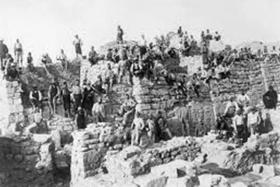
Further destruction of Troy was committed in the late-19th century, with the early and crude excavations carried out by amateur archaeologist Heinrich Schliemann. In his quest to quickly expose and confirm the Homeric city of the Trojan War and discover any of Priam's treasure, he had a huge trench dug out of the Hissarlick hillside, that tragically destroyed many parts of the historic city. Some later archaeologists sarcastically claimed that Heinrich Schliemann's excavations were carried out with such rough methods that he did to Troy what the Greeks couldn't do in 10 years, by destroying and levelling most of Troy VIIa city walls using dynamite.
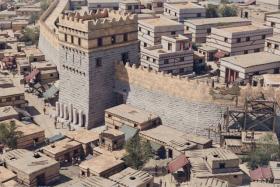
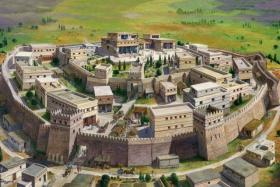
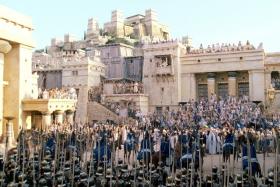
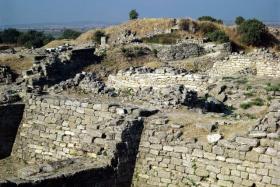
During the Late Bronze Age, about 1750–1180 BC (Troy VI & VIIa), the large citadel was enclosed behind impressive sloping walls, parts of which can still be seen at the site today, and there is evidence of a large settlement in the lower town to the south. This city level VIIa was the Late Bronze Age Troy that was destroyed by the Achaean Greeks in the Trojan War in 1183 BC. Troy was finally abandoned around 1100 BC for the next four centuries of the Greek Dark Ages. Troy was later visited by Alexander the Great in the Spring of 334 BC during his invasion of the Persian Empire. The Romans sacked, then rebuilt the last city of Troy IX in 85 BC.
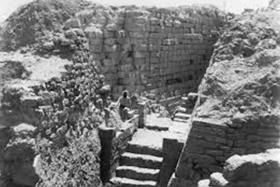
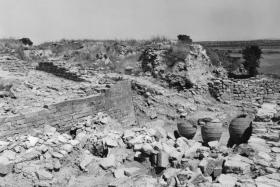
There have been many dates submitted as to the fall of Troy, from 1240 BC to 1178 BC. However, it was Eratosthenes of Cyrene, the founder of scientific chronology, that tried to fix the dates of ancient literary and political events using Egyptian and Persian records, to estimate the date of the fall of Troy to late Spring 1183 BC. Eratosthenes, who studied in Alexandria and Athens, was a mathematician, geographer and astronomer who became the third chief librarian/director at the Library of Alexandria. He died in 195 BC and was best known for being the first person to accurately calculate the Earth's circumference and the Earth's axial tilt.
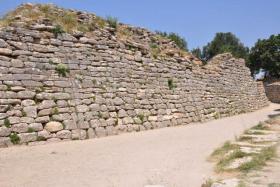
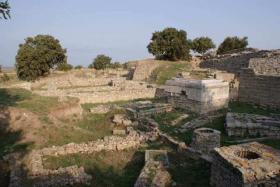
*There is no mention of any wooden horse in Homer's epic Iliad and his Odyssey poems, as he only gives a very vague description about a hippos (hippoi) made of planks. Although Hippos is Greek for horse, the ancient Greeks, Trojans and Phoenicians also referred to their ships as 'sea-horses' with many vessels having a horse's head as a 'figurehead' on the bow of their wooden ships. Also ancient siege machines, used to assault walled cities, were covered with damp horse-hides for protection, so we only read about a 'wooden horse' from the Roman historian Virgil in his Aeneid, Book II, translated into Latin many centuries after the event.
The archaeological ruins of Troy were enrolled as a UNESCO World Heritage site in 1998.