Greek Christmas Traditions
24 December 2025 - 11:00am
 Greek Christmas traditions blend Orthodox faith with unique historical customs, centering on family feasts, decorative Christmas boats (Karavaki) replacing trees in older traditions, carol singing (Kalanda) by young children with triangles and drums and Saint Basil (Aghios Vasilis) bringinging gifts on New Year's Day with a special cake (Vasilopita) alongside delicious sweets like melomakarona and kourabiedes. Every culture has its own unique, quirky customs and traditions, and Greece is no exception as it seems to have more than its fair share of Christmas and New Year celebrations. Greek Father Chrismas is not Saint Nicholas or Santa Claus, but Saint Basil (Aghios Vasilis) but being Greek and true to form, he arrives a whole week late, on New Year's Eve, when most Greeks recieve their presents.
Apart from the traditional Christmas tree, introduced to Greece in 1833 by King Othon (the first king of independent Greece who was originally a Bavarian prince) the idea of trees didn't really become popular until the early 1940s. Prior to this, as Greece is a maritime country, Greeks used to decorate wooden boats (Karavaki) especially on Greek islands, coastal ports and fishing villages.
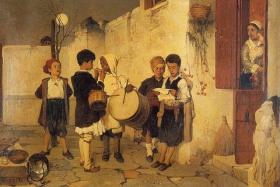

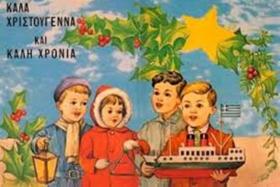
Modern Greek carol singers are primarily children going door-to-door singing traditional kalanda carols with triangles on Christmas Eve, New Year's Eve and Epiphany Eve, 5th January. With carols rooted in ancient Greece and evolving through the centuries, they go from house to house, asking "Na ta poume?" (Shall we sing?) and receive money and sweets in return for their singing.
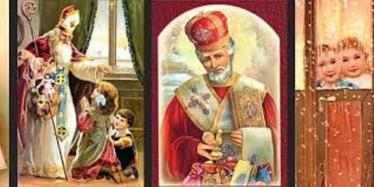

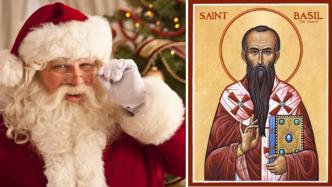
While children in Greece open their gifts on 1st January, delivered by Aghios Vasilis, AD 330-379, the Western European and North American tradition of Father Christmas, delivering presents on Christmas Eve, has become increasingly popular in Greek households in recent years. As a result, children often receive gifts on both dates, many mistakenly merging the two similar traditions into one. To add even more confusion, we must remember and include Saint Nicholas, best known as the inspiration for the modern-day figure of Santa Claus. Born in the the then-Greek town of Patara, he was elected bishop of Myra in Asia Minor in the fourth century AD. Nicholas took part in the Council of Nicea in AD 325, where the Creed that Christians believe in was first formulated. The saint, who died in in AD 343, has gone on to be remembered for his generosity, eventually transforming into the jolly man with the red hat who loved to give presents to others. He was said to have left gifts in secret, such as putting coins in shoes that had been left out for him. He eventually became known forever after as Santa Claus, with 'Claus' being the German version of the name Nicholas. The feast day of Saint Nicholas is celebrated on 6th December, and Saint Basil on the 1st January.
From Saint Nicholas Day on 6th December, until the Feast of the Epiphany on 6th January, Greeks watch over their homes especially carefully, looking for moved items or stolen Christmas goodies. That’s because, according to Greek folklore, a group of tiny devilish goblins, called Kalikantzaroi, come out during the whole holiday period, hoping to wreak some havoc on mankind. The Kallikantzaroi come up to the world during this period every year beacause Christ has not yet been baptized and therefore cannot protect humanity from evil. On 6th January, the Epiphany, which commemorates both the day the three Magi (wise men) visited Jesus and the day Jesus was later baptized, the Kallikantzaroi are forced off the planet surface and return back down to the base of the tree of life to discover that it has been healed. They then have to start their dastardly work all over again.