Heatwaves & Wildfires
15 August 2025 - 7:30pm
 With a persistent summer heatwave across Greece and Southern Europe during most of July, it has led to dry, parched and arid conditions in forests and the open countryside. As strong gale-force winds started in the first weeks of August, it brought the threat of wildfires, which sadly and tragically came true. Greece, Spain and Portugal have ordered mass population evacuations after wildfires threatened to scorch towns and villages across all three countries. In the previous week, thousands of French firefighters battled a deadly 39,536 acre wildfire (an area equivalent to one-and-a-half times the size of capital city Paris) near to Ribaute in Southern France, that claimed at least one life, with others missing, as torrid drought conditions helped fuel wildfire growth across the whole of Southern Europe.
In the Greek port city of Patras, firefighters struggled to protect homes and farms from flames that tore through pine forests and olive groves, with a hospital and carehome evacuated. At least 15 firefighters have been hospitalised or received medical attention for burns, smoke inhalation or exhaustion. Local media reported that two young men were arrested for arson late Wednesday evening on charges of setting the fire that first broke out on Tuesday 12th August in the Syhena district of Patras. The flames, fuelled by extremely strong winds, have damaged an unknown number of homes, businesses and at least two monasteries. Greece has also sent reinforcements to neighbouring Albania, which is struggling to contain dozens of wildfires. The EU has rushed aid to countries hit hard by the fires, including non-member states like Montenegro in the Balkans region. At least 3 people have died as the European Commission said requests to help tackle wildfires reached the same count as for the whole of 2024.
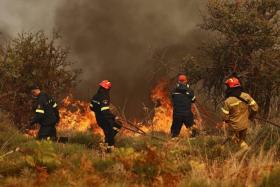
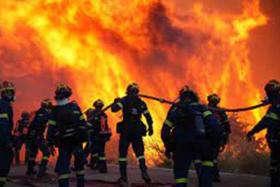
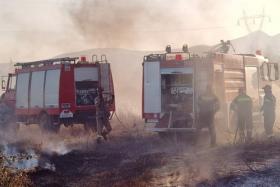
Nearly 1,500 people, most of them tourists, were evacuated from hotels and homes on the island of Crete, near Ierapetra on Thursday 14th August, as more than 200 firefighters struggled to control a wildfire in arid conditions in the sweltering heat, their work made more difficult by gale-force winds and rugged mountain terrain. In the recent weeks, wildfires have devastated tens of thousands of acres of land in Greece. Last month, a wildfire on the island of Chios burned nearly 15,000 acres of forest, as officials safely evacuated dozens of communites. With temperatures still high across the whole country, a high risk of wildfires remains.
On Friday 15th August, in the early afternoon, a firefighter battling flames near Patras, fell into a ravine. He was rescued by his colleagues, suffering injuries to his legs and lower back. Closer to home, a wildfire broke out before 3pm on Friday in a rural-forest area near Pelei, Argolida. Pelei is a small semi-deserted rural village, 7kms from the Kranidi to Epidavros main road, with a population of 15 residents. Firefighters reported the flames moving towards a hillside, away from nearby homes, but strong winds prompted a quick and large response to prevent the fire from spreading. About 60 firefighters, 4 specialised ground teams, 14 fire-vehicles, 6 water-bombing planes and a helicopter were soon battling the blaze, with additional support from local water trucks.
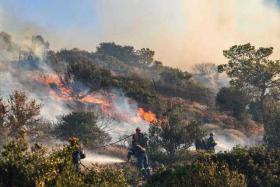
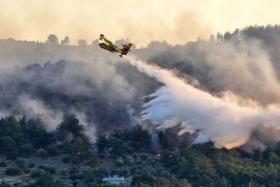
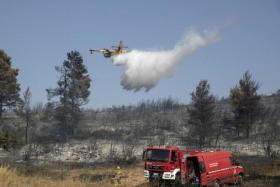
In Greece, more than 18,000 firefighters (15,500 permanent and 2,500 seasonal personnel) will be deployed across the whole country, marking a 20% increase from 2023 and the largest force in Greece's history. They will be supported by approximately 4,000 trained volunteer firefighters and 5,700 civil protection volunteers from 295 organisations. Specialised forest operation units now number 1,600 individuals across 20 teams. Greece's firefighting capabilities consist of up to 85 firefighting aircraft, 49 of which are leased, 3,700 fire-engines and 85 aerial surveilance drones equipped with thermal cameras, double that of last year's number.
Under the EU Civil Protection Mechanism, a further 294 firefighters from the Czech Republic, France, Romania, Moldova and Bulgaria will be prepositioned in Greece to assist in firefighting efforts.
On Sunday 17th August, a firefighter died after an accident during firefighting efforts when his truck fell down a steep hill in the Castile and Leon region of Spain. In neighbouring Portugal, where wildfires are also still blazing, another firefighter was killed in a tragic accident, and a man has died after being run over by a bulldozer he was operating while fighting wildfires, as the death toll from this summer's Southern European wildfires has risen to five, with many more seriously injured.
Greece reported that summer 2025 was the third hottest in 65 years, following the hottest ever summer of 2024.